

Turning toxic dirt into green gold
Transitioning from his master’s to a doctoral program in environmental science, Jacob Galloway is using the "superpowers" of plants to clean toxic landscapes — pioneering a future where the metals in our technology are grown and recycled, not just mined.
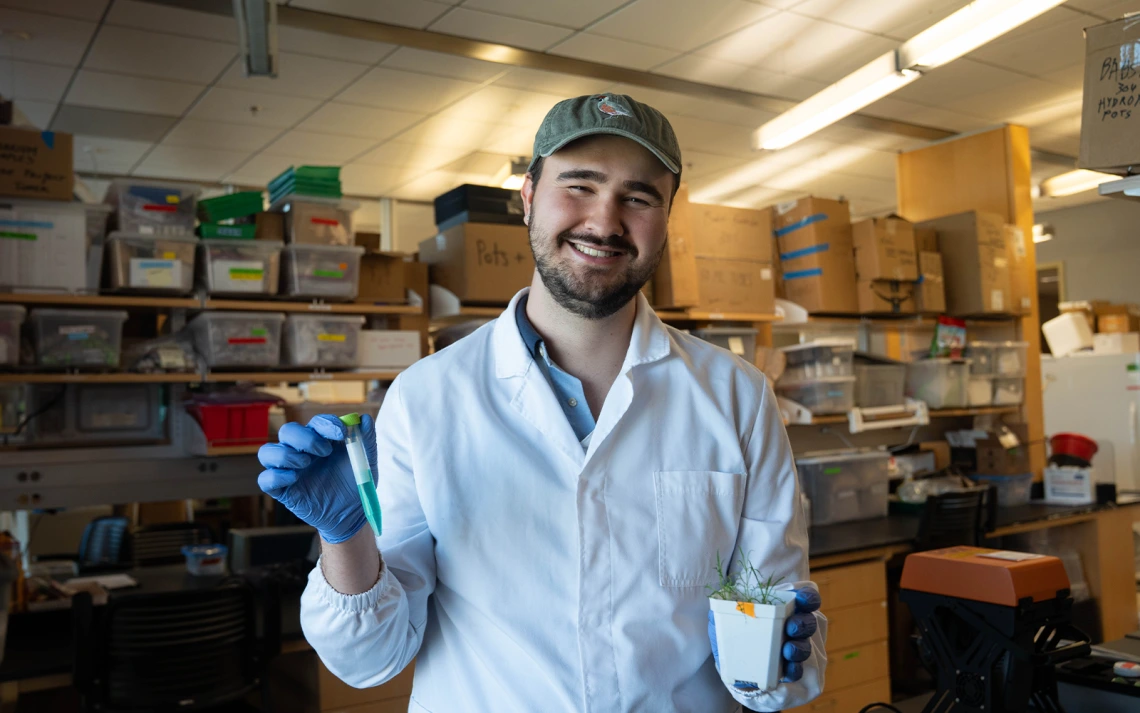
Jacob Galloway is a MS/PhD in Environmental Science at the University of Arizona working in the Alicja Babst-Kostecka lab located in the BIO5 Institute.
Lily Howe, BIO5 Institute
Every smartphone, electric vehicle, and medical device on the planet shares a 'dirty' secret: the techniques used to mine the metals needed for them often leave behind a trail of toxic dust. Traditional mining uses heavy machinery that leaves deep scars, saturating the surrounding earth with heavy metals to the point where the soil itself becomes poisonous to living things. Currently, the standard 'cleanup' involves burying the soil underground, a method that merely stores the soil without changing its toxicity. As the global demand for critical minerals, such as nickel and cobalt, reaches all-time highs, scientists are looking for a more elegant, quieter, and greener solution.
From pressed flowers to powered plants
For Jacob Galloway, an MS/PhD environmental science student at the University of Arizona, the interest in solving industrial pollution began when he was still a kid. Long before Galloway collected data in laboratories, he was a young boy walking through the woods with his grandfather, the hobby that planted the seeds for a lifelong interest in the natural world.
“From a young age, I loved nature,” Galloway recalls. “I would spend many afternoons pressing flowers into notebooks.”
That childhood curiosity and passion for nature continued as Galloway pursued higher education. During a soil study for a campus community garden at the University of Arizona, he saw firsthand how the health of the earth determined the health over everything above it. Inspired by the way soil chemistry could impact an entire ecosystem, Galloway sought out a mentor who shared his vision. This led him to the laboratory of Alicja Babst-Kostecka, an associate professor of environmental science and director of the Center for Environmentally Sustainable Mining (CESM). Now, working within the center located in BIO5 Institute, he is proving that plants are much more capable than meets the eye.
An appetite for metal
Galloway's research involves a fascinating ability belonging to few plants, known as hyperacumulation. While most plants find metals toxic, some species can actually thrive off them. These special hyperaccumulators pull metal out of the soil and absorb it into their leaves.
“Hyperaccumulating plants take up heavy metal contaminants from the soil into their biomass," Galloway explained. “You can use them to clean up mining sites by having the plant suck up the contamination and then you remove the plant, or you can use them to phytomine, which is taking the metal out of the plant to use for something else.”
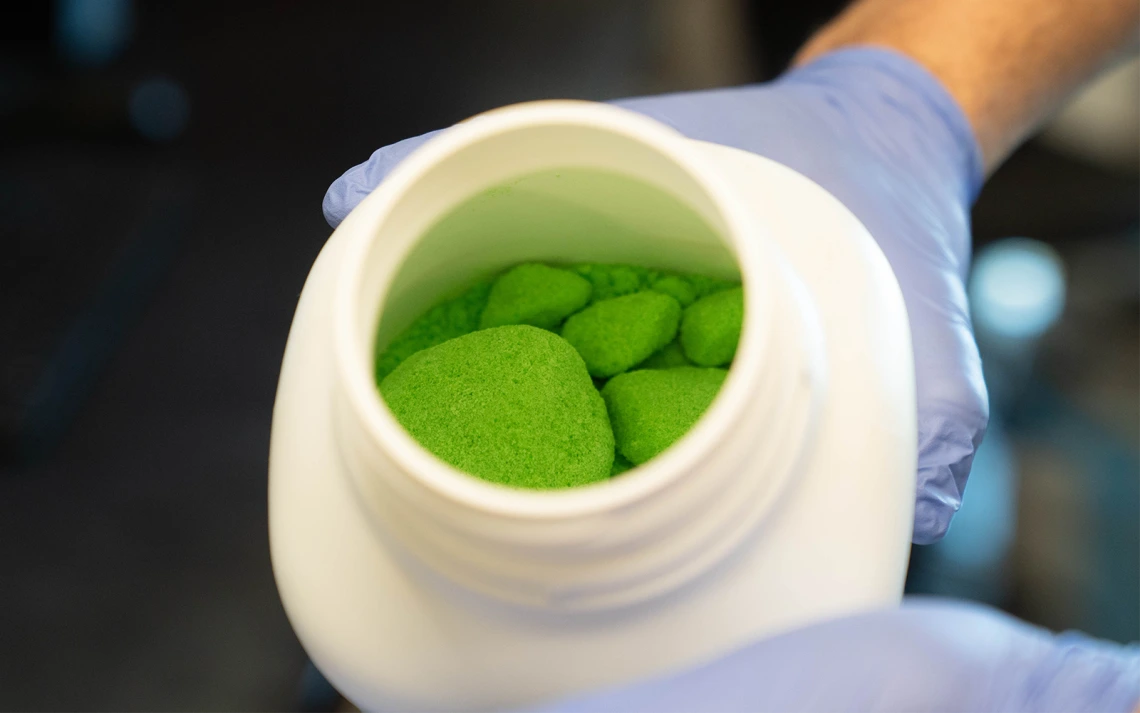
Nickel salt, used to make a metal solution for plant growth studies.
Lily Howe, BIO5 Institute
Galloway's primary focus is on Streptanthus polygaloides, a California native plant that specializes in nickel absorption. He studies which populations of this plant perform best, and how environmental factors influence its “appetite” for metal.
Using a portable X-ray fluorescence device, Galloway measures metal levels in a plant. The device shoots radiation into the plant and determines what metals are present by measuring how the radiation bounces back. While this device is not uncommon in mining industries, the Babst-Kostecka lab uses a special version optimized for dried plant material. This technology allows the lab to scan large amounts of dried specimens in hope of finding the next generation of metal absorbing plants.
"It makes science not a question of what is possible, but where you actually want to go,” Galloway said. "We can feasibly do a lot, which is really exciting."
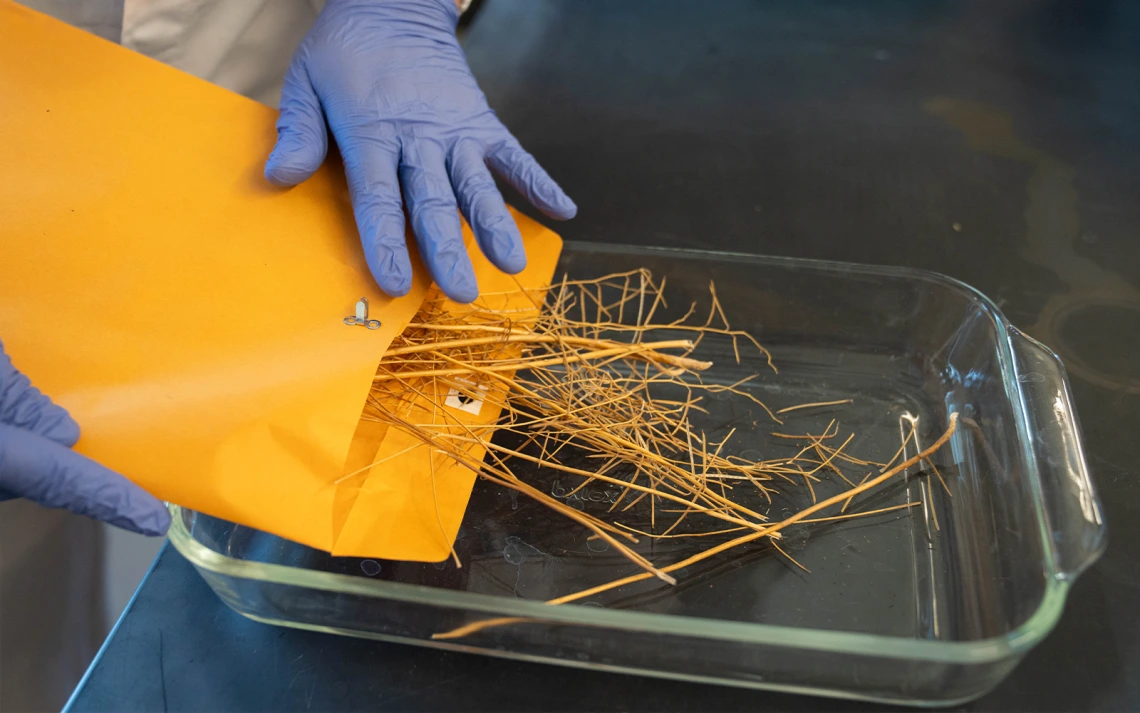
Dried plants are prepared for scanning; to record the heavy metals the plant "sucked up" during its growth cycle.
Lily Howe, BIO5 Institute
Galloway’s time at the BIO5 Institute has taught him that being a scientist requires more than just technical skills; it requires the ability to translate data into real world solutions that others can understand. Besides his research, Galloway is involved in scientific outreach. He values communicating environmental concepts to many different audiences, from K-12 students at the Southern Arizona Regional Science and Engineering Fair (SARSEF) to Arizona legislators on "Mining Day at the Capitol."
By breaking down the walls between these different environments, BIO5 gives Galloway a special platform to bridge the gap from the lab to the public.
Sowing the seeds of science
As Galloway continues his academic journey, graduating with his master’s this summer and moving into a doctoral program at the University of Arizona with the Babst-Kostecka lab, he encourages other students to start small. His own path began with washing lab trays and sieving soil. While these tasks felt insignificant in the beginning, they built the foundation for his current research path.
“You learn a thousand things you didn’t know while working toward one goal,” said Galloway. “Reach out to people because you’re interested, it's a big mental hurdle, but it will be okay.