

Focusing the lens on ovarian cancer
Graduating with her master’s in biomedical engineering, Lynette Valenzuela uses light to study fallopian tube tissue — work that advances ovarian cancer detection while helping launch her career in medical innovation.
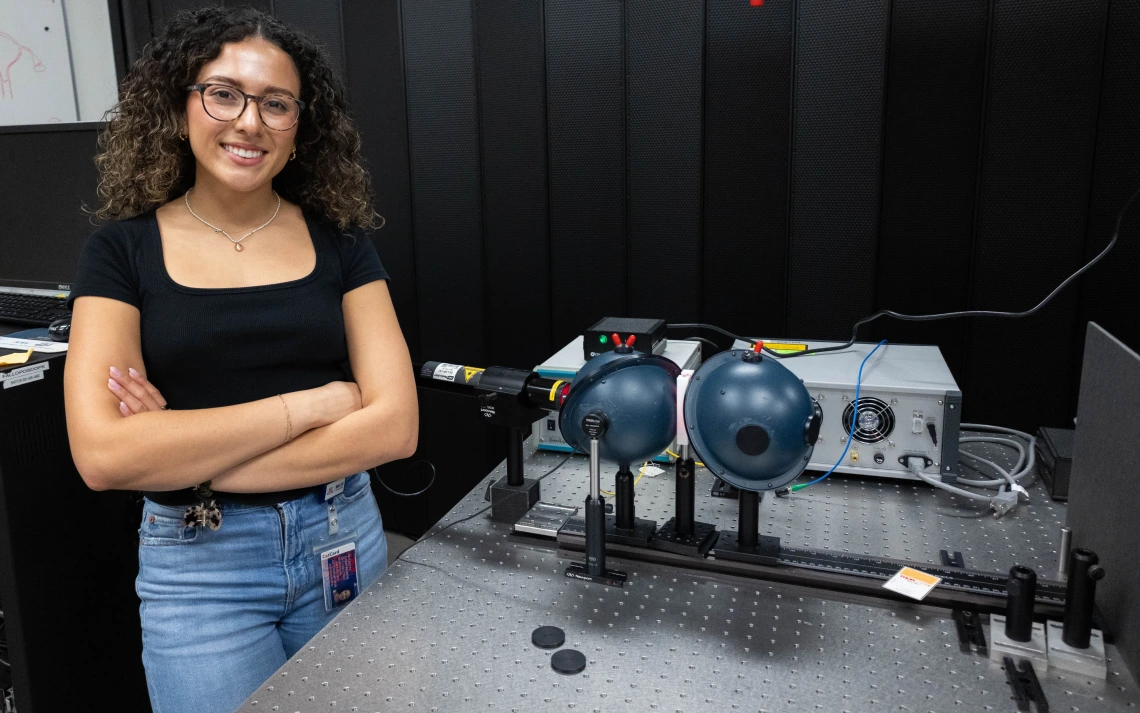
Lynette Valenzuela will be graduating in spring 2026 with a master’s degree in biomedical engineering and hopes find in career in medical innovation.
Caroline Bartelme, BIO5 Institute
Ovarian cancer is considered the deadliest gynecologic cancer, despite being only the eleventh most common cancer among women. Notoriously difficult to detect at its early and most treatable stages, this cancer is often discovered far too late. While the metrics are daunting, researchers at the University of Arizona are using the power of light to help change this narrative.
For Lynette Valenzuela, a second year student in the biomedical engineering accelerated master’s program, the fight against cancer is an optical challenge. She works under the mentorship of Jennifer Barton, interim vice provost for health programs and professor of biomedical engineering at the University of Arizona. Valenzuela researches how light interacts with human tissue to pave the way for potentially life saving diagnostics tools.
The spark of engineering
Valenzuela was interested in medical innovation before she ever entered a university lab.
“My interest in biomedical engineering began in high school when I learned about the total artificial heart and its impact on patients,” said Valenzuela. “Seeing how engineering principles could directly improve and save lives motivated me to pursue this path.”
As a biomedical engineering major at the University of Arizona, she joined the Undergraduate Biology Research Program (UBRP), designed to teach students science by involving them in laboratory or field work. Through the UBRP, she was introduced to Barton’s work in tissue optics — the study of how light moves through biological tissues — which ultimately led her to join Barton’s lab in the U of A College of Engineering, located in the BIO5 Institute.
Lasering in on the data
Valenzuela’s research focuses on the fallopian tubes, where most ovarian cancer is believed to originate. Her work involves a sophisticated device that captures how light is reflected and transmitted through tissue, called a double integrating sphere system.
By shining lasers through human and animal tissue samples, Valenzuela measures precise optical properties like absorption and scattering. This data is vital because it validates the use of animal tissue for testing in pre-clinical research.
“I shine a laser through one side, and the tissue sample sits in between the spheres,” Valenzuela explained. “I get reflectance data from one sphere and transmittance data from the other.”
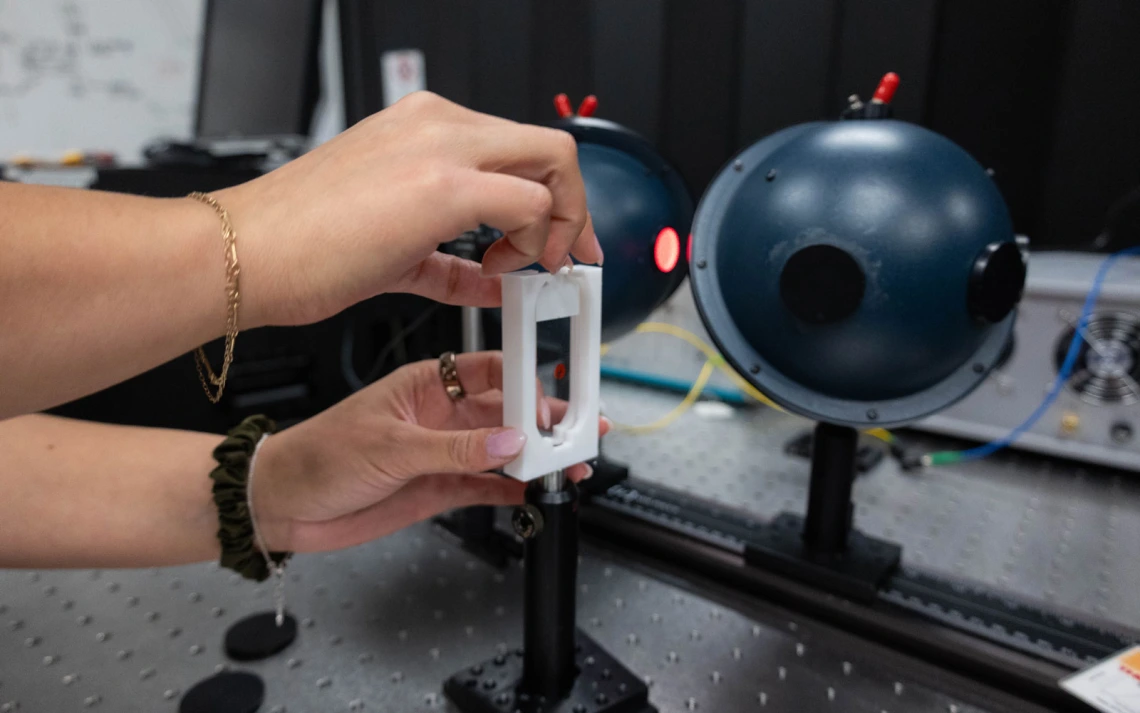
Valenzuela carefully places a tissue sample into the holder between two integrating spheres. By measuring how light is both reflected and transmitted through these samples, she can identify the unique "optical fingerprint" that distinguishes healthy tissue from early-stage cancer.
Caroline Bartelme, BIO5 Institute
She uses a specific algorithm to extract a very precise ‘optical fingerprint’ of the tissue by measuring how much light is absorbed versus how much light gets scattered. Her findings have already shown lots of similarities between human and animal tissue, validating the use of animal tissue as a reliable alternative to human tissue for pre-clinical optical research.
“This shows the strong agreement between human and porcine tissue samples,” Valenzuela explained. “It supports the development of light-based strategies for early ovarian cancer detection.”
Illuminating the path: From student to scientist
For Valenzuela, BIO5 is more than a building with equipment — it is a community that fosters the next generation of scientists through interdisciplinary collaboration.
“One of the best strengths of the BIO5 Institute is the collaborative environment,” Valenzuela noted. “Researchers from different disciplines work closely together, which encourages innovation and new ideas.”
This environment at BIO5 helped Valenzuela transition from a student interested in science to a confident researcher. She credits hands-on experience and mentorship as being vital to her growth.
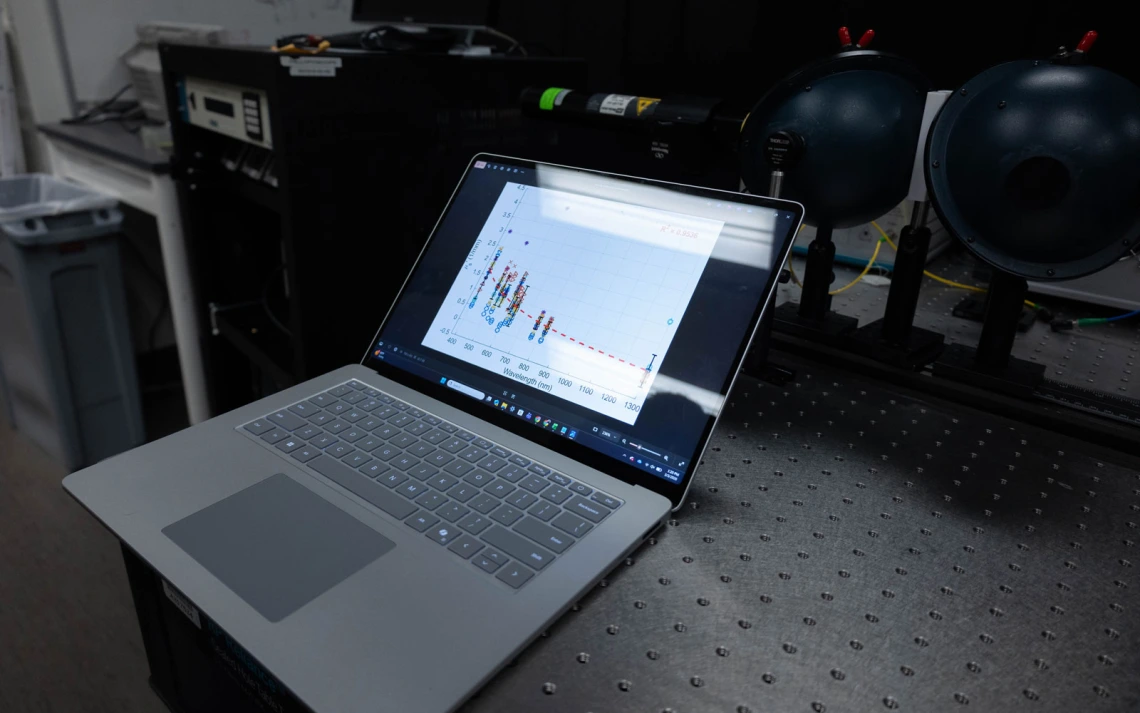
A data plot on Valenzuela’s laptop shows the successful correlation between optical properties that is part of her research focused on early ovarian cancer detection.
Caroline Bartelme, BIO5 Institute
“Working closely with faculty mentors showed me that I am capable of tackling complex problems,” she said. “Presenting my work at conferences reinforced my understanding and helped me grow more confident in my abilities as a scientist and engineer.”
Valenzuela’s time at BIO5 is a precursor to a career in medical innovation. As she graduates in May 2026, she is looking toward a future in the medical device industry where she can use the skills and strategies she’s developed in a collaborative workspace.
For aspiring researchers looking to follow in Valenzuela's steps, she has some final advice:
“Don’t be afraid to ask questions. Many opportunities begin with a simple conversation or email. Labs value enthusiasm and a strong work ethic.”