

U of A researchers, startup recognized at 2026 AZBio Awards
The University of Arizona earns two honors at the 2026 AZBio Awards for bioscience education and cancer detection innovation.
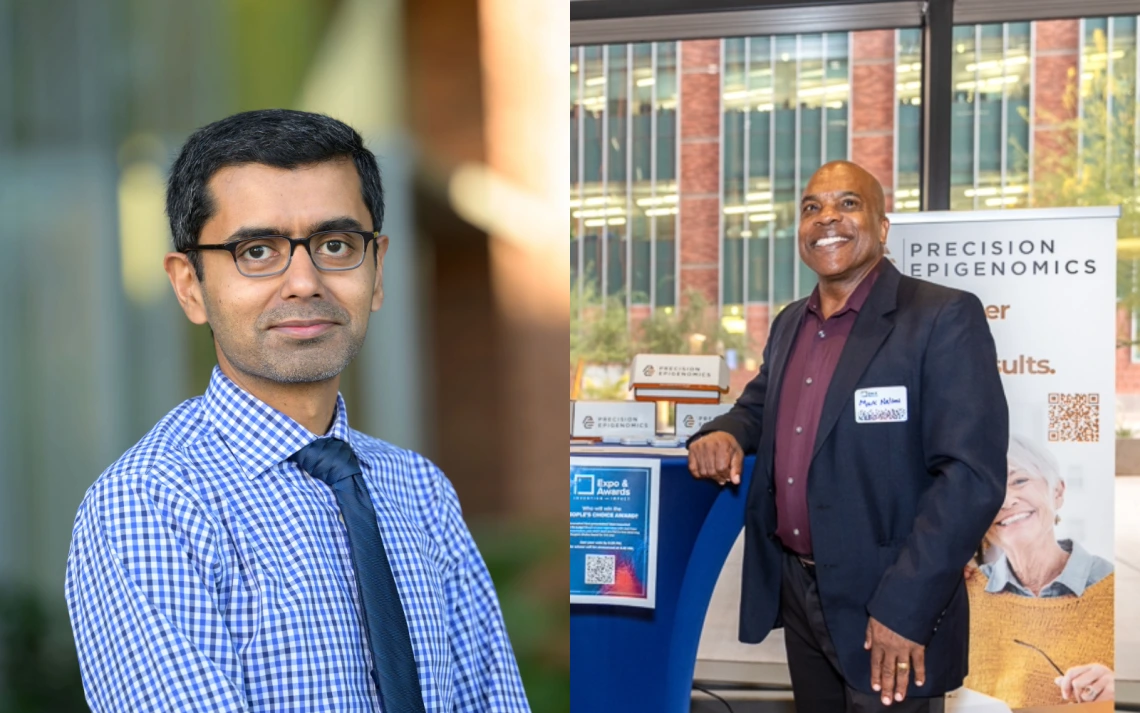
The University of Arizona will be well represented at this year’s AZBio awards, with BIO5 Interim Director Vignesh Subbian taking home the Michael A. Cusanovich Bioscience Educator of the Year award and startup Precision Epigenomics winning a Fast Lane recognition.
The AZBio Awards, hosted by the Arizona Bioindustry Organization, celebrate healthcare innovation and honor leaders from across the state of Arizona who illustrate the depth and breadth of the state’s booming life science industry. The awards are presented annually as part of Arizona Bioscience Week.
“These two honors capture the full arc of what research at the University of Arizona makes possible,” said Tomás Díaz de la Rubia, University of Arizona senior vice president for research and partnerships. “Vignesh Subbian has built pathways that give young people opportunities to grow from their first research experiences through advanced training, with mentorship along the way. Precision Epigenomics shows what is possible at the other end of that arc: university research translated into a blood test, now in use for patients, that can detect more than 60 types of cancer. Arizona’s bioscience economy depends on both the people we train and the discoveries we bring to market.”
Vignesh Subbian: Michael A. Cusanovich Bioscience Educator of the Year Honoree
Subbian, who holds joint appointments in Biomedical Engineering and Systems Engineering, is being recognized as Educator of the Year for his design of a longitudinal research and mentorship continuum that spans from high school to postdoctoral training. Since his arrival at the University of Arizona, he has established three separate programs to provide students dedicated research training with built-in mentorship, as well as helped existing training programs at the BIO5 Institute grow and expand.
At BIO5, he previously served as Associate Director for Education and helped champion the Keep Engaging Youth in Science (KEYS) Research Internship, recognizing it as a vital entry point into research careers. This year, he also established a new graduate fellowship in interdisciplinary research designed to give doctoral students experience in convergent research and mentorship.
In addition to his work at BIO5, Subbian has established three additional vital training initiatives across the university: SABER (Strengthening Arizona’s Biomedical Engineering Research Workforce), which provides first- and second-year undergraduates with mentorship and paid research position, PHIRE (Place-based Health Informatics Research Education), which provides mentorship and place-based research training, connecting students to health challenges that relate to the broader Southwest region and their own communities and interests, and eCAMINOS (engineering pathways), which provides need-based scholarships and mentorship to engineering students at the University of Arizona's Tucson and Yuma campuses, helping them recognize their unique strengths and life experiences as assets for success in their careers.
Precision Epigenomics: Fast Lane Honoree
Precision Epigenomics is one of three companies receiving the Fast Lane award, which celebrates ventures that have achieved outstanding milestones in the past 18 months.
The startup is a molecular diagnostics innovator working to transform cancer care, building on the research of professor of pathology and company CEO Mark Nelson and others associated with the College of Pharmacy, the BIO5 Institute, and the University of Arizona Cancer Center.
With business formation and development support from the university’s commercialization arm, Tech Launch Arizona, Nelson and his team have received funding and additional support from the Flinn BioEntrepreneurship program as well as a Small Business Innovation Research (SBIR) grant from the National Cancer Institute. They have made significant strides in transforming cancer diagnostics; their EPISEEK® Multi-Cancer Early Detection test is now available and in use for patients. The test analyzes circulating tumor DNA (ctDNA) shed by tumors and looks for unique epigenetic modifications; it can detect over 60 types of cancer from a simple blood draw.
The awards will be presented at a ceremony on October 7 at the Phoenix Convention Center.