

How BIO5 is changing the questions scientists can ask
From cells to systems to a lifetime, researchers at the University of Arizona BIO5 Institute are asking new kinds of questions about health and disease.
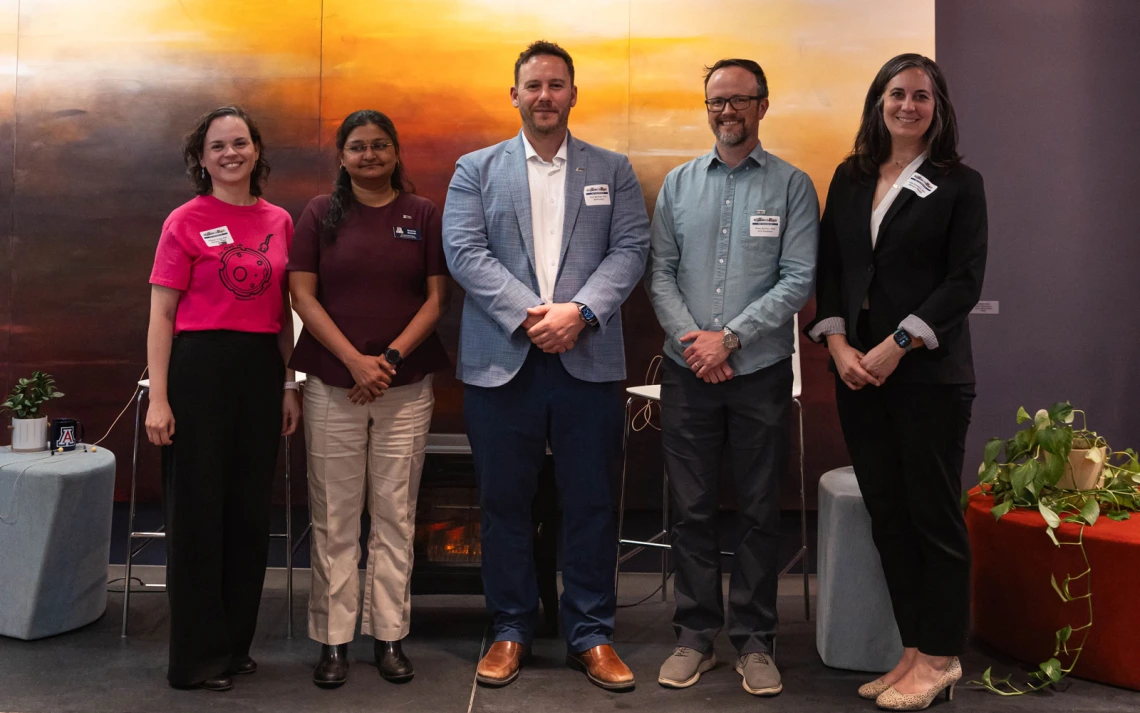
(Left to right) Zelieann Craig, Swarna Ganesh, Alex McGhee, Ross Buchan and Elise Erickson are University of Arizona researchers and members of the BIO5 Institute whose work spans organoids, ALS and women’s health.
Lily Howe, BIO5 Institute
Not long ago, scientists studying disease were limited to simplified cell systems or animal models, tools that couldn’t fully capture how human biology works.
Now, researchers can take cells from a patient’s tumor, place them into a three-dimensional model and begin asking a more precise question: which immune cells recognize the cancer and which do not?
That shift is subtle, but important. It marks a move from approximating disease to studying how it behaves in a specific individual.
At the BIO5 Institute, changes like this are reshaping not just how research is done, but what scientists are able to ask about how disease behaves in a person, how it moves through the body and how health develops over time.
As BIO5 marks its first 25 years, this shift is helping define how the next 25 years of research will be done.
Building models that reflect real human biology
Swarna Ganesh and Alex McGhee, both assistant professors of biomedical engineering and BIO5 faculty members, are building three-dimensional models of human tissue, organoids that more closely reflect how the body works.
For decades, researchers relied on simplified systems or animal models. But those approaches don’t always translate to human biology, especially for complex systems like the immune response.
Organoids change that.
Ganesh’s lab uses light-based printing to create structures where cells can grow into functional tissue.
“What this gives us is control. We can decide how cells are arranged and how they interact, which means we can start asking much more specific questions about disease,” Ganesh said.
That level of control makes more advanced experiments possible.
McGhee’s lab approaches the problem differently, focusing on how cells can build and organize those structures themselves, creating systems that evolve over time. The two approaches come from different directions, but together they make it possible to design experiments that neither could do alone.
“We can take a patient’s cancer, place immune cells near it and watch how those cells behave over time,” McGhee said. “Then we can start to ask what makes one cell effective at killing cancer while another ignores it.”
That question, why one cell responds and another doesn’t, is difficult to ask in traditional models. In a system built from a patient’s own cells, it becomes possible to observe those differences directly.
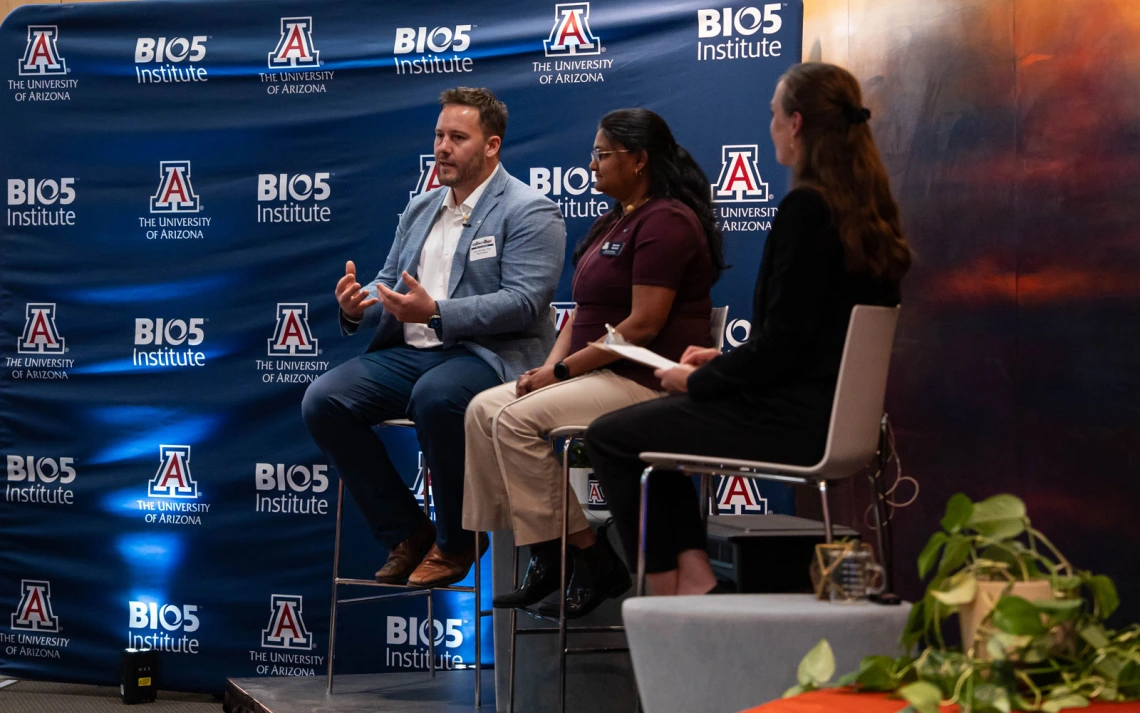
Alex McGhee (left) and Swarna Ganesh (right) are combining their complementary bioengineering approaches to make organoid models more consistent, scalable and useful for studying disease.
Lily Howe, BIO5 Institute
Together with support from BIO5, Ganesh and McGhee are working to make organoids consistent, scalable and accessible so they can be used reliably across labs as tools for testing drugs and studying disease.
The goal is no longer just to model disease, but to understand how it behaves in a specific patient and test how those responses might change.
Tracing how disease moves through the body
In ALS, that shift starts with a pattern.
Clinicians have long observed that amyotrophic lateral sclerosis, ALS or Lou Gehrig’s disease, is a fatal neurodegenerative disease that often begins in a hand or foot and spreads along predictable pathways through the nervous system.
That pattern raised a different kind of question for researchers in the lab.
Instead of focusing only on what goes wrong inside a single cell, researchers began asking whether the disease itself could move between cells, spreading damage through connected networks of neurons.
BIO5 faculty member Ross Buchan studies how cells regulate RNA, the system that controls how proteins are made and how cells respond to stress. When that system breaks down, it can contribute to diseases like ALS.
“If the same breakdown in RNA regulation is happening from cell to cell, then the question isn’t just what goes wrong. It is how that damage moves through the system,” said Buchan, an associate professor of molecular and cellular biology.
If that spread can be tracked, it may also be possible to slow or interrupt it.
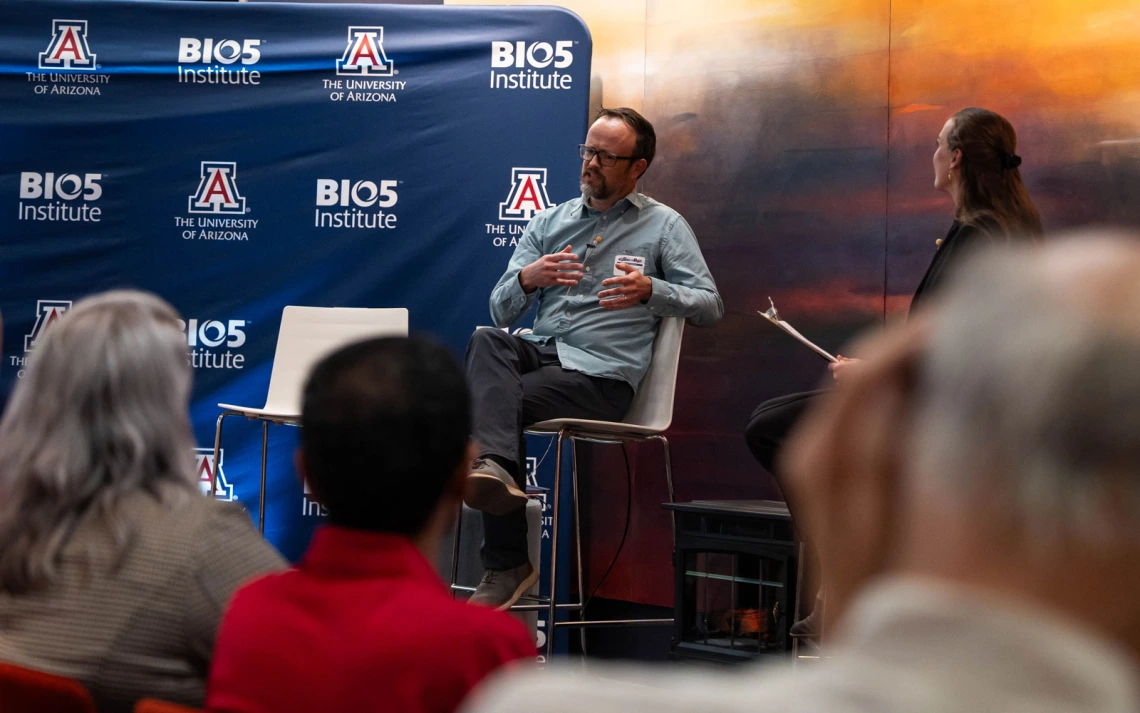
Ross Buchan (left) studies how disruptions in RNA regulation contribute to amyotrophic lateral sclerosis (ALS) and is part of a group building a statewide research network to connect basic science with clinical work.
In that context, collaboration makes it possible to ask a different kind of question, from what happens inside a single cell to how disease moves through the body.
“If we keep approaching ALS in pieces, we’re going to keep getting partial answers and miss how the disease progresses,” Buchan said.
Along with his close collaborator Kevin Rhine, assistant professor of pharmacology and toxicology and BIO5 faculty member, Buchan aims to build a connected ALS research community with BIO5 support that links basic scientists and clinicians to better understand how the disease progresses and to develop earlier, more targeted approaches to diagnosis and treatment.
Understanding health across a lifetime
BIO5 faculty members Zelieann Craig and Elise Erickson are approaching women’s health from different perspectives, reframing how health is defined over time.
Craig, an associate professor of animal and comparative biomedical sciences, is a toxicologist who studies how environmental exposures affect the reproductive system. Erickson, an associate professor of physiology, is a certified nurse-midwife and researcher studying pregnancy, childbirth and maternal health in real-world settings.
Historically, fertility, pregnancy and long-term health have often been treated as separate problems. But that separation leaves critical gaps.
“We tend to treat pregnancy or fertility as isolated moments, but they’re shaped by everything that comes before and they shape what comes after,” Erickson said.
Craig’s work brings in a factor that is often missing from that conversation: environmental exposure.
“A lot of what shapes reproductive health happens before someone ever sees a doctor and we’re not always accounting for that,” Craig said.
Those exposures are often missing from clinical conversations, even though they may shape outcomes long before a patient enters care.
Together, their work is moving women’s health beyond isolated moments to asking how early exposures, biology and care interact to shape outcomes across a lifetime.
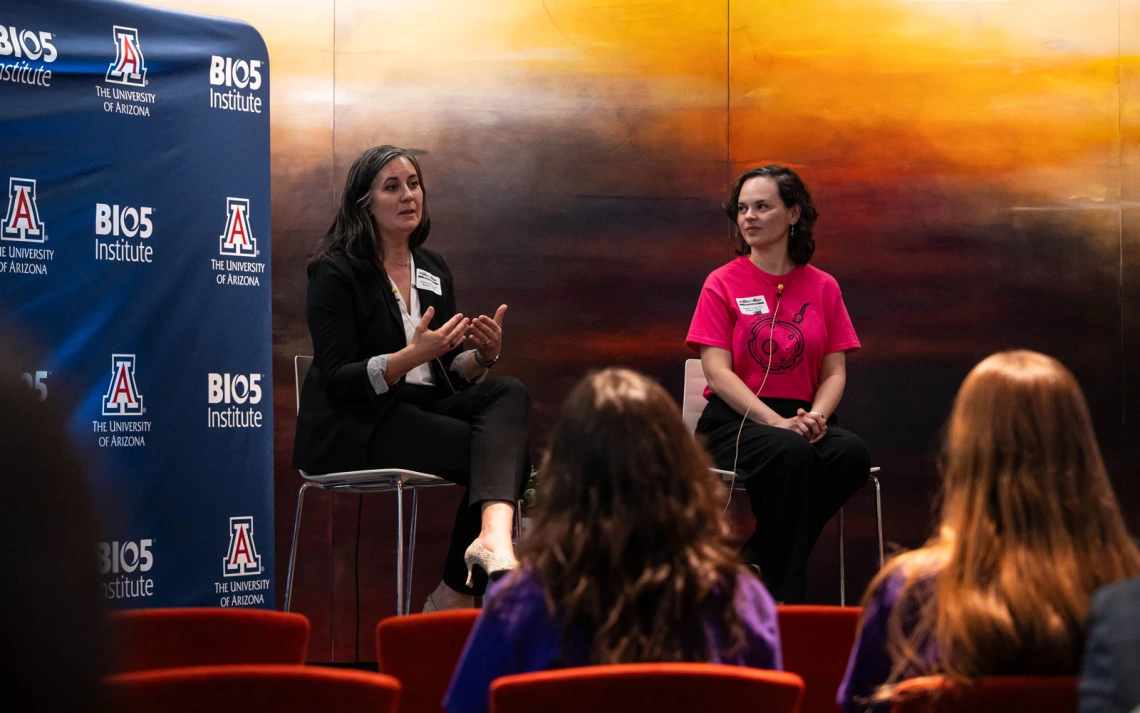
Elise Erickson (left) and Zelieann Craig (right) are part of a women’s health collaboration linking lab research with clinical care to better understand how environmental exposures, biology and pregnancy shape health from fertility through postpartum.
This opens the door to earlier, more proactive approaches to care that can identify risk before problems arise and better support women’s health over time.
Craig and Erickson are part of a broader effort at the BIO5 Institute to connect research, clinical care and lived experience so those insights can translate into practice.
From cells to systems to a lifetime
Researchers are no longer limited to asking what happens in a single system or at a single moment. Instead, they are asking how biology connects across cells, across systems and across a lifetime.
At BIO5, those kinds of questions are possible because researchers from different fields are working together—an approach that is shaping how research will be done over the next 25 years.
These BIO5 faculty members are part of several emerging BIO5 Scientific Interest Groups focused on the bioprinting of organoids, ALS research, and women’s health across the lifespan. These SIGs serve as a “sandbox” for convergence research in biosciences by bringing together people and resources from multiple disciplines in intentional and meaningful ways.