

How a brain parasite persists — and the scientist studying it
Chandrasekaran “Arun” Sambamurthy at the University of Arizona studies how the parasite Toxoplasma survives inside the human brain, research shaped in part by the BIO5 Postdoctoral Fellowship.
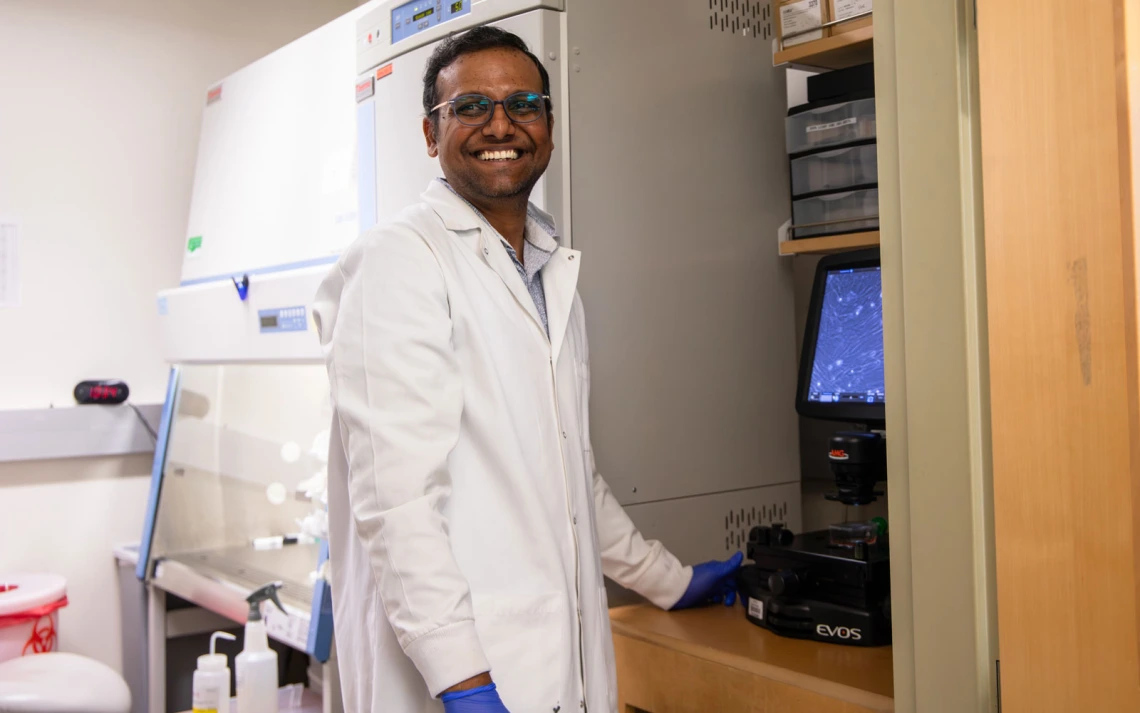
Chandrasekaran “Arun” Sambamurthy studies how the parasite Toxoplasma gondii survives inside neurons, combining parasite biology, neuroscience and immunology to understand how infections can persist in the brain.
Lily Howe, BIO5 Institute
When Chandrasekaran “Arun” Sambamurthy describes his research, it can sound like science fiction: a microscopic parasite infects a person, slips into the brain and waits for the immune system to falter.
But unlike an action-packed science-fiction story, the real-life version usually ends quietly. In most people, the immune system keeps the parasite under control, and they live their entire lives without knowing it was ever there.
The parasite is Toxoplasma gondii. It infects people through contaminated food or environmental exposure, and Sambamurthy studies how it persists in the brain after infection.
“Toxoplasma quietly infects about 30% of the world’s population and can live in the brain for a lifetime,” said Sambamurthy, an assistant research scientist in the lab of Anita Koshy at the University of Arizona College of Medicine – Tucson. “Understanding how this parasite coexists with our neurons is critical if we want to prevent devastating disease when the immune system is compromised.”
Chandrasekaran “Arun” Sambamurthy, PhD
Lily Howe, BIO5 Institute
In people with healthy immune systems, the parasite typically remains dormant, forming cysts inside brain cells that can persist for decades without causing symptoms.
But when the immune system is weakened — such as in organ transplant patients, people undergoing chemotherapy or individuals with untreated HIV infection — those cysts can reactivate and cause serious disease. Infection during pregnancy can also be dangerous because the parasite may be transmitted to a developing fetus. In severe cases, the infection can cause brain inflammation, seizures and other neurological complications.
The parasite survives inside neurons and offers scientists a rare opportunity to study how immune responses operate in the brain, a question relevant to neurological diseases such as multiple sclerosis and Alzheimer’s disease. Infection occurs worldwide, and researchers like Sambamurthy are working to understand how the parasite survives inside neurons and establishes long-lasting infections in the brain.
For Sambamurthy, curiosity about strange forms of life started long before he began studying parasites in the laboratory.
Following a curiosity for parasites
As a middle school student in India, Sambamurthy was initially fascinated by space and galaxies. Over time, that curiosity shifted from distant planets to life on Earth. He became intrigued by organisms whose behavior can be as complex as anything found on other planets.
After earning his doctorate studying Leishmania donovani, a parasite that infects immune cells, Sambamurthy wanted to explore how intracellular parasites behave in other types of cells. He became particularly interested in Toxoplasma, which — unlike Leishmania — can infect neurons and persist in the brain.
When he began looking for a lab to pursue those questions, he reached out to Koshy, professor of neurology and immunobiology at the University of Arizona.
“What I remember most is Arun sending me a very personalized email explaining his doctoral work and why he wanted to learn more about Toxoplasma,” said Koshy, a BIO5 Institute member since 2012. “He was incredibly thoughtful and already had a clear idea of the direction he wanted to take as a scientist.”
Sambamurthy joined the Koshy lab in 2016 as a postdoctoral researcher and began studying how Toxoplasma infects neurons. At the time, the lab primarily relied on animal models to study infection.
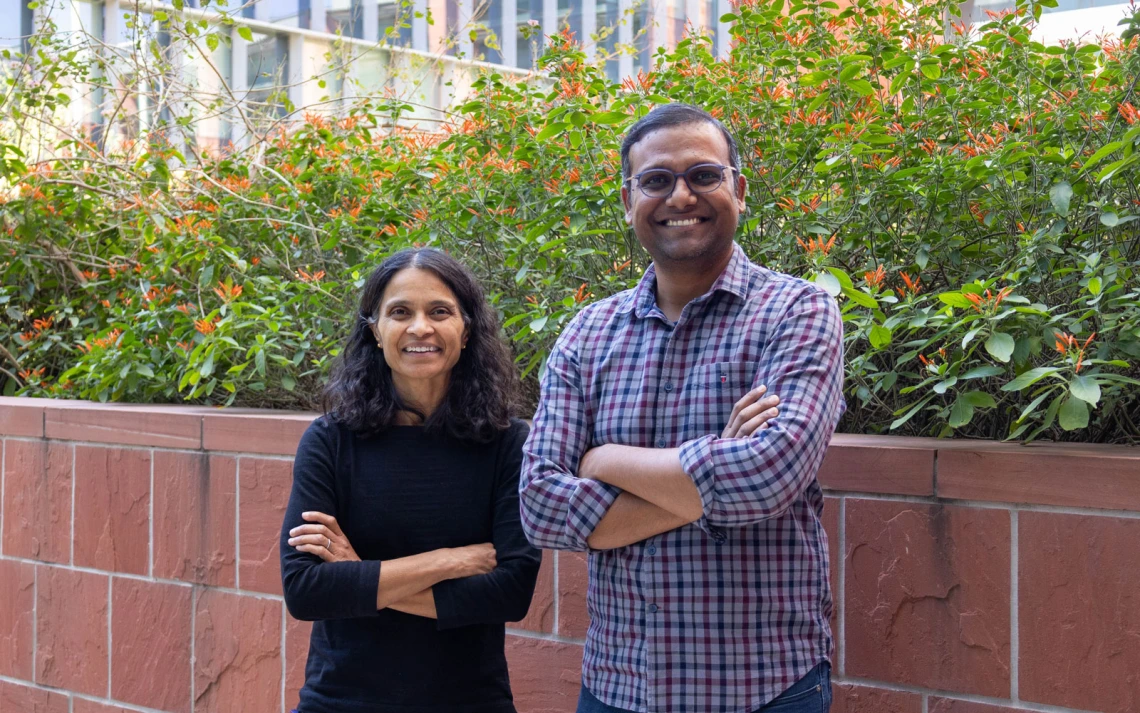
When Sambamurthy (right) joined the lab of Anita Koshy (left) at the University of Arizona as a postdoctoral researcher, they began collaborating to understand how the parasite Toxoplasma survives inside animal brain cells.
Lily Howe, BIO5 Institute
But Sambamurthy believed that studying the parasite in human neurons could reveal new insights into how it behaves in the brain.
Pursuing that idea would require learning techniques the lab did not yet use.
Growing human neurons to study infection
In 2019, a new opportunity at the BIO5 Institute gave him a way to pursue that idea. The institute was launching a postdoctoral fellowship designed to support early-career scientists pursuing interdisciplinary research with BIO5 faculty members.
Sambamurthy was selected as part of the program’s first cohort. Since then, the BIO5 Postdoctoral Fellowship has supported more than 50 early-career researchers across disciplines at the University of Arizona, many of whom have moved on to academic, industry and research careers. Sambamurthy is one of several fellows who have remained at the university, continuing to expand collaborative research.
“I used funds from the BIO5 Postdoctoral Fellowship to travel to Phoenix to learn a new technique for growing human neurons from stem cells,” said Sambamurthy. “The fellowship gave me the support and confidence to learn these methods in a hands-on setting and bring them back to the lab.”
Sambamurthy spent several days in the lab of Rita Sattler, an associate research scientist at the University of Arizona College of Medicine – Phoenix and professor of translational neuroscience at the Barrow Neurological Institute, to learn how to derive human neurons from induced pluripotent stem cells (iPSCs).
“I knew nothing about growing human neurons,” said Koshy. “This was Arun’s idea for how to gain that expertise and bring it back to our lab. It’s one of his great traits as a person and scientist — he’ll take an idea and just run with it.”
Sambamurthy and the Koshy lab hope to understand how brain cells limit the parasite and how it adapts to survive inside neurons by comparing how Toxoplasma behaves in animal and human neurons.
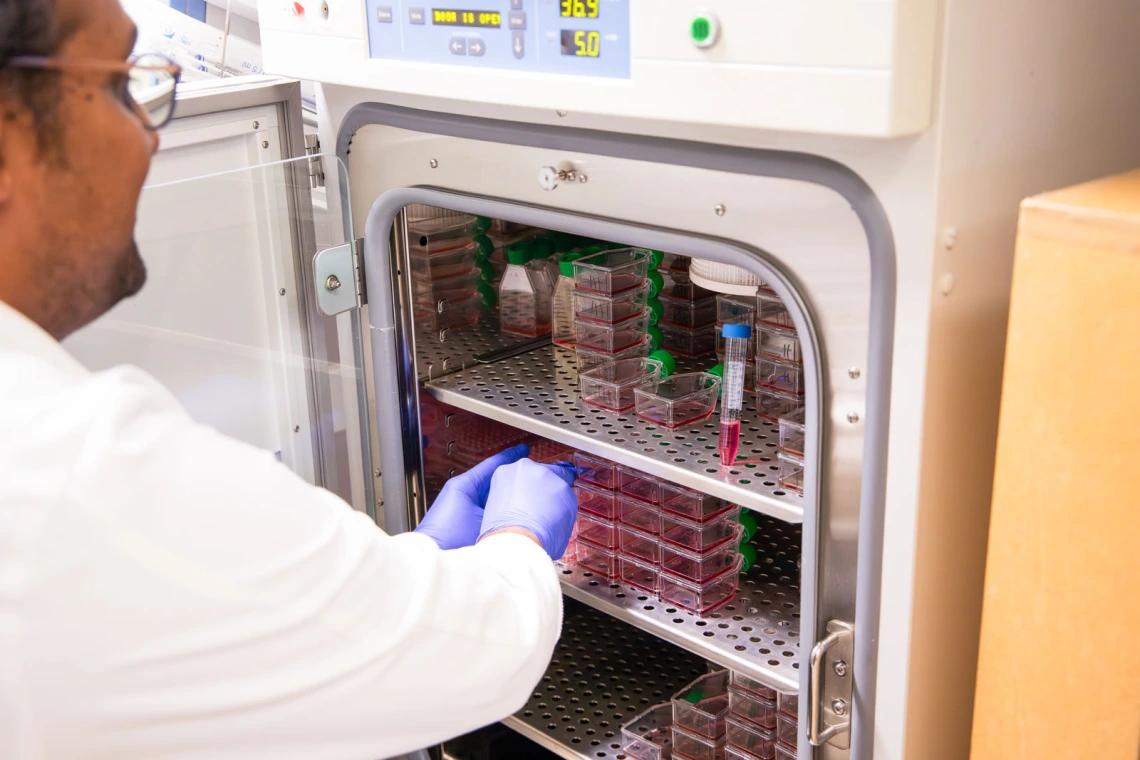
Sambamurthy works with cultured cells in the Koshy lab at the University of Arizona, where techniques he developed during the BIO5 Postdoctoral Fellowship help researchers study how Toxoplasma behaves inside human brain cells.
Lily Howe, BIO5 Institute
Exploring how the parasite persists
By 2021, Sambamurthy was hired as an assistant research scientist in the Koshy lab.
Building on momentum from the BIO5 Postdoctoral Fellowship, he began expanding the lab’s work on how Toxoplasma survives in neurons. He also designed a project to develop new tools for studying Toxoplasma infection in human neurons, which Koshy and collaborators submitted as an exploratory grant to the National Institutes of Health in 2023.
Although some of the project’s original experimental plans proved technically difficult to implement, the work produced an important new tool: a human neuron model lacking the gene STAT1, a key regulator of immune responses, allowing researchers to better study how brain cells respond to Toxoplasma infection.
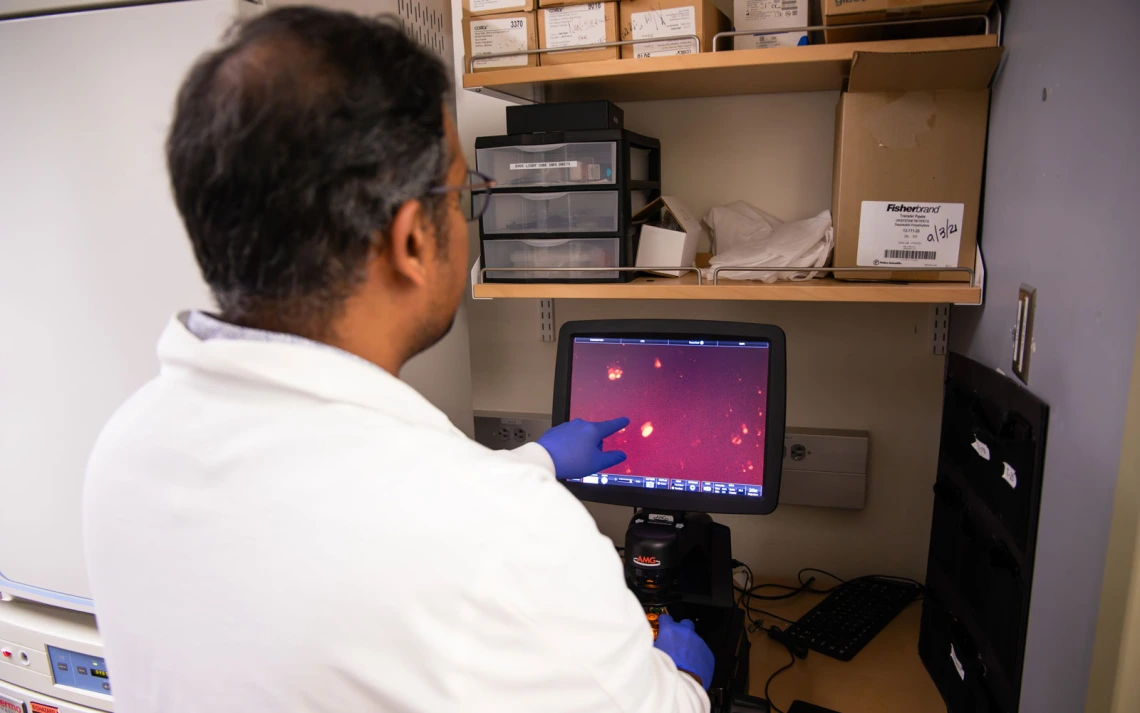
Sambamurthy builds on fifteen years of parasite biology to develop new tools for studying Toxoplasma infection and how immune responses operate in the brain.
Lily Howe, BIO5 Institute
As the project progressed, it also pushed Sambamurthy to think about the problem differently. While much of the lab’s work had focused on how neurons respond to infection, he began asking a complementary question: what is the parasite itself doing to survive in the brain?
That shift led to an unexpected observation.
While reviewing results from a graduate student comparing two strains of T. gondii, Sambamurthy noticed a tiny protein that became highly active when the parasite entered a slower-growing form that allows it to establish long-lasting infections in the brain.
“I was interested in understanding how such a small protein could be involved in stage conversion,” Sambamurthy said, referring to the parasite’s shift from its fast-growing form into a dormant, cyst-forming stage. “It had appeared in several studies in the field, but no one had really followed up on it.”
That curiosity quickly became a new direction for the lab.
“It was this weird little protein that kept showing up,” Koshy said. “That made us think it might be doing something important in the parasite’s transition to the persistent stage.”
“So, our lab took up the challenge of figuring out where this tiny protein might lead us,” Sambamurthy said.
Now Sambamurthy and Koshy are developing a new line of research around that question.
Using the human neuron systems Sambamurthy helped establish, the lab is designing experiments to test whether the protein helps trigger this shift into the cyst-forming state that allows the parasite to remain inside neurons for years.
Passing the mystery to the next generation
“My lab today would not exist without Arun,” said Koshy. “He helped set up both animal and human neuron systems, starting from stem cells. He mentors students in the lab every day. He’s taken every challenge with confidence and grace, and the breadth of techniques he’s learned is remarkable.”
The techniques Sambamurthy once traveled to learn as a BIO5 Postdoctoral Fellow are now part of the lab’s everyday work. Today, he passes that knowledge to high school, undergraduate and graduate students in the lab.
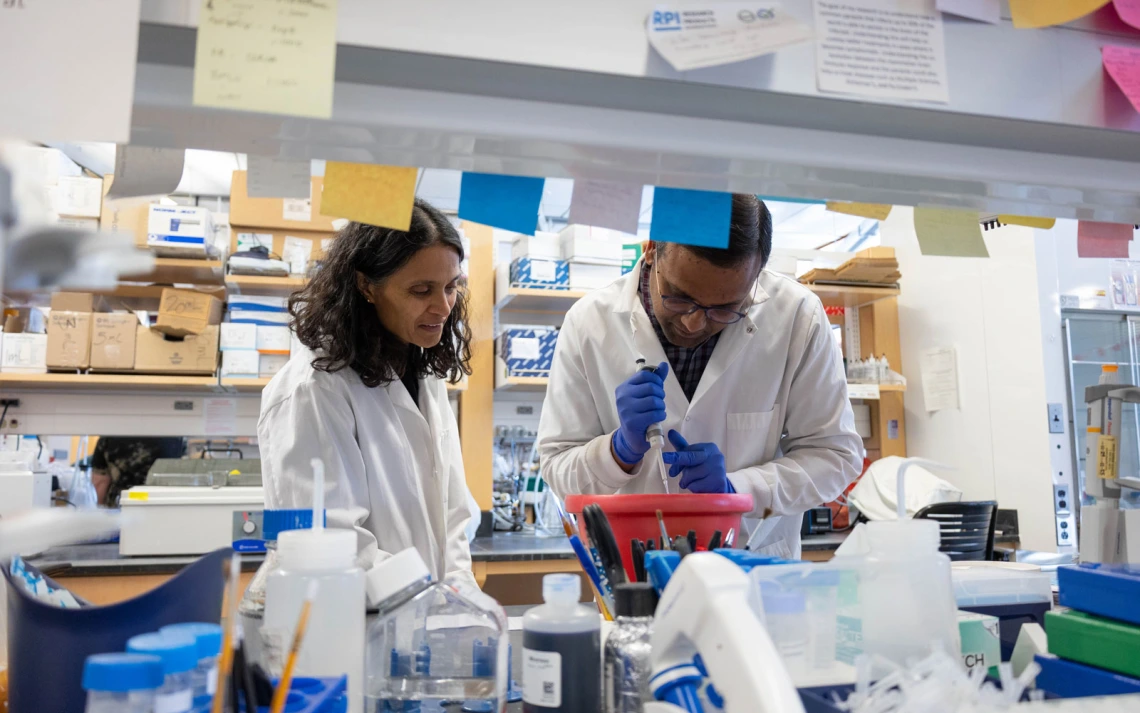
Koshy says Sambamurthy has been instrumental in her lab, helping establish neuron systems that have driven the lab’s Toxoplasma research forward and mentoring the next generation of scientists using those same tools.
Lily Howe, BIO5 Institute
“One of the most rewarding parts of my work has been mentoring students at different stages of their careers,” Sambamurthy said. “Working with them helped me discover another side of myself as a scientist.”
Today, the students Sambamurthy mentors are using those same tools to investigate the question that first drew him to the Koshy lab: how a parasite that sounds like science fiction can survive inside the human brain.
The BIO5 Postdoctoral Fellowship supports University of Arizona postdoctoral researchers pursuing interdisciplinary research with BIO5 faculty members. Since 2019, the program has provided funding and professional development to help fellows launch the next stage of their scientific careers. Applications for the next cohort are now open and will close April 20, 2026. Learn more on the fellowship website.