

The University of Arizona BIO5 Institute celebrates 25 years of research and impact
The University of Arizona BIO5 Institute, a leader in collaborative bioscience research, celebrates its 25th anniversary in 2026 with celebrations throughout the year, beginning with the Behind BIO5 event on Thursday, April 9.
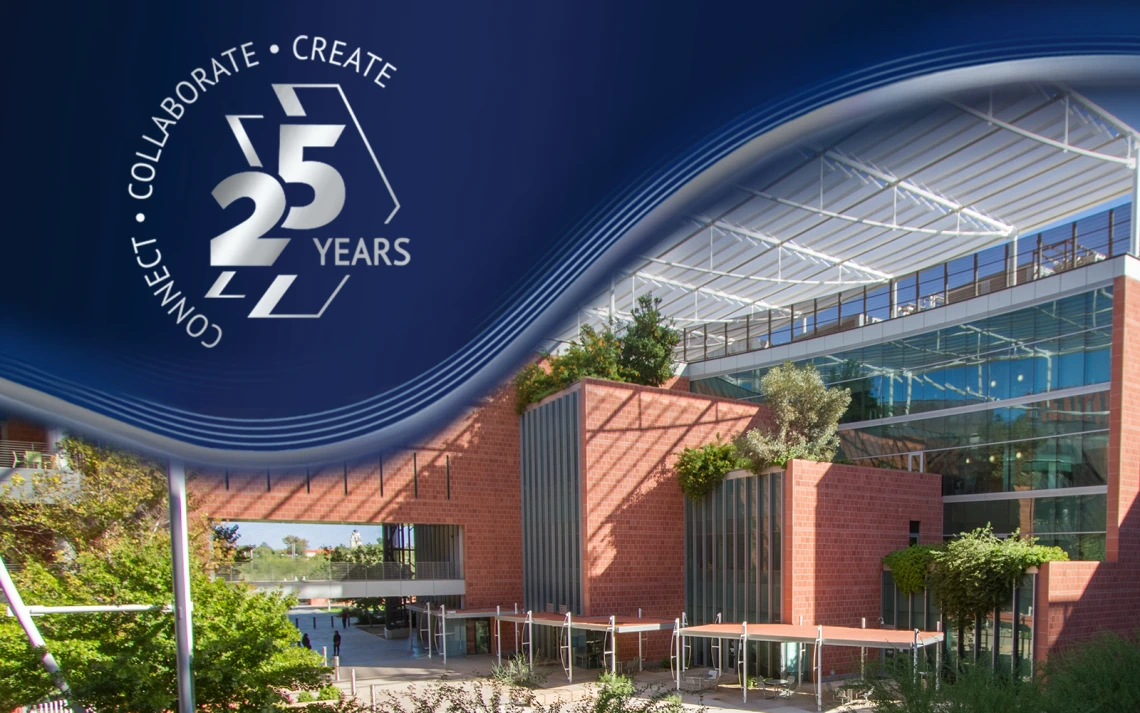
Since its founding, the institute has brought together a dynamic network of some of the brightest minds in bioscience at the University of Arizona to work together on bold solutions for evolving disease, nutrition, food safety, health, and other biology-based challenges that affect Arizona and the world beyond.
BIO5 began with a grand challenge — what if there were a hub for collaborative research where scientists from all kinds of disciplines could come together to solve pressing biomedical issues? Through the dedication of former University of Arizona President Peter Likins, the philanthropy of Thomas W. Keating, and funding provided by Proposition 301, BIO5 evolved from an idea to a reality.
“Twenty-five years ago, the BIO5 Institute was founded on the visionary principle that the world’s most complex biological challenges require a radical departure from siloed research. Today, that foresight has matured into a premier hub of convergent science,” said Tomás Díaz de la Rubia, senior vice president for research and partnerships. “As we celebrate this milestone, we recognize BIO5 as a cornerstone of our research enterprise – a place where discovery is translated into the tangible health and environmental solutions that improve lives across Arizona and the global community.”
BIO5 was initially a virtual institute but quickly began the planning for a physical space, which came to life with the construction of the Thomas W. Keating Bioresearch Building, one of the first spaces of its kind. Built around collaboration, the building features both space for labs and offices, but also common areas where researchers from different teams can meet and share ideas. With the addition of the Bioscience Research Laboratories in 2017, the space available expanded and now houses 65 faculty member labs and nine core facilities.
In addition to physical space, BIO5 provides intellectual, organizational, and shared research infrastructure that helps faculty members collaborate across disciplines, facilitates team-based projects, and offers a framework of support for researchers, their work, and the training and public programs organized by the Institute.
"For a quarter century, BIO5 has been a model for transdisciplinary research and a genuine contributor to improving health for people across Arizona and beyond,” said Vignesh Subbian, interim director of BIO5. “That work happens because of an integrated infrastructure that weaves together collaborative intellect, organizational capacity, students and trainees, faculty investigators, and industry and community partners.”
The Institute now includes 300+ faculty members whose areas of research range from aging and early cancer diagnostics to sustainable mining and plant root architecture. These members represent 19 colleges and 80 departments, and all chose to join BIO5 to indicate their dedication to transformational convergent research. In fiscal year 2025, investments into BIO5 resulted in more than $128 million in new grants and gifts to further this work.
BIO5 faculty members have always embraced the idea of translating research into societal impact. Through a close partnership with Tech Launch Arizona that began in 2013, members have formed 61 startups and received over 300 patents, helping bring the research from bench to bedside and to the people who need it most.
Looking forward
BIO5 has always been at the forefront of shaping the future of bioscience research and talent development, with a keen eye on mentoring the next generation of scientists and bringing research together across disciplines.
The BIO5 Institute’s Keep Engaging Youth in Science Research Internship (KEYS) offers Arizona high school students the opportunity to spend seven weeks participating in research with faculty and scientists across the University of Arizona. They receive training and mentorship while actively engaging in research projects. Now in its 20th year, KEYS has over 800 alumni from throughout the state, many of whom are actively publishing scientific articles, working in STEM fields, and pursing advanced scientific degrees. BIO5 also hosts a postdoctoral fellowship, offering support, mentoring, and professional development to early career researchers, and will soon launch a graduate fellowship to offer the same to doctoral students.
Beginning this year, BIO5 faculty members are coming together from multiple disciplines in new scientific interest groups (SIGs) to tackle grand challenges by approaching them from different research angles. Initial groups include researchers gathering around ALS, women’s health across the lifespan, and bioprinting. BIO5 acts as a sandbox for these interest groups, offering foundation and infrastructure to support the idea that big problems need collaborative thinking.
“Looking ahead, our goal is to strengthen our infrastructure in concrete ways: making existing research resources more accessible, investing in new shared technologies and resources that open doors across disciplines, and increasing the visibility of the people who drive the research and training mission,” said Subbian. “The next frontier of biomedical and biological research is being shaped by those who think across disciplinary boundaries, and BIO5 exists to ensure the University of Arizona is at the center of that."
The community is invited to celebrate BIO5’s anniversary and learn more about the behind-the-scenes workings of research at Behind BIO5, a free public event on Thursday, April 9 from 4:30 – 6:00 pm at the Thomas W. Keating Bioresearch Building. BIO5 faculty members will have hands-on discovery tables that showcase their research, and fireside chats will dive into the importance of collaboration with speakers from the SIGs.
Learn more about the history of BIO5: https://bio5.org/milestones